Look up! Double sky show features eclipse and Perseids meteor shower
The partial solar eclipse will be a very shallow one here in the tri-state area. Only a very small sliver of the sun will get blocked out by the moon in our local sky.


The month of August is packed with fun night sky events. Coming up next week is a partial solar eclipse and a well-known meteor shower. Both are happening right in the middle of the week on Wednesday.
The partial solar eclipse will be a very shallow one here in the tri-state area. Only a very small sliver of the sun will get blocked out by the moon in our local sky. North America is not in the path of totality this time. This solar eclipse will be seen primarily across the Atlantic in parts of Greenland, Iceland and Spain. This means that our sky will not get dark and you will need eclipse eyewear protection. Do you still have those solar eclipse glasses from the last eclipse?
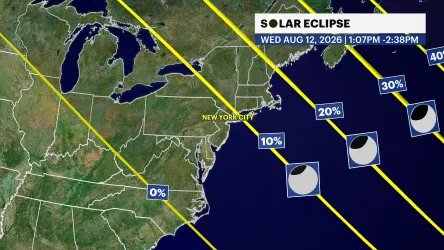
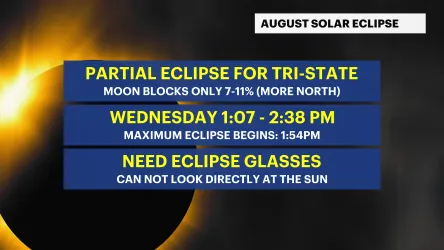
The partial eclipse starts at 1:07 p.m. and concludes at 2:38 p.m. The maximum eclipse happens at 1:54 p.m. The New York City area will only see about 9.5% of the sun get covered. Areas farther north and east up through Connecticut will see 11%. Areas further south down near Trenton, New Jersey will only see about 7%.
Starting Wednesday morning, a well-known summertime meteor shower is back! The Perseids will peak next week.
The shower pops up every year from late July through Sept 1, when the Earth travels through the debris field left from comet Swift-Tuttle. This year, the Earth will pass through the densest part of the trail starting during the pre-dawn hours of Wednesday morning, Aug 12 and lasting through the morning of Aug 13. This will be the best time to see the most meteors, which some people refer to as “shooting stars.”
Comet Swift-Tuttle was discovered separately by two different astronomers, and it visits the inner solar system every 130 years. It leaves just enough of a debris trail behind to help create some swift and bright meteors that it’s known for.
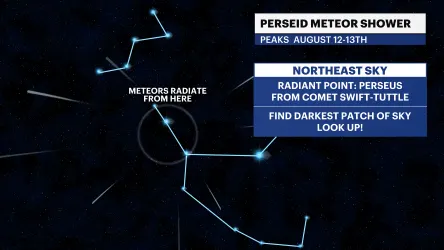
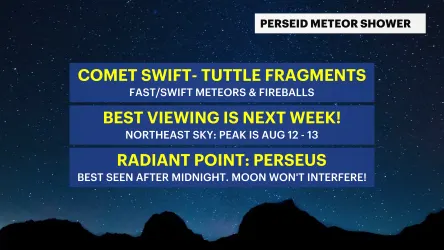
You can just about see a meteor in any part of the sky, but the point they seem most to appear from is in the constellation Perseus. That’s how this shower got its name. Perseus is one of the 48 ancient constellations listed by the 2nd-century astronomer Ptolemy. Perseus was the Greek mythological hero who beheaded Medusa.
Perseus rises high in the northeastern sky late at night. That’s why these meteors are best seen well past midnight. Most seem to appear during the pre-dawn hours.
How to view:
The best part about viewing meteor showers is that all you need to do is look up! Find the darkest patch of sky out there. It doesn’t have to be in the direction of the constellation either. They will pop up almost anywhere.